
Frozen Chicken: Net Weight, Glaze and Carton Checks
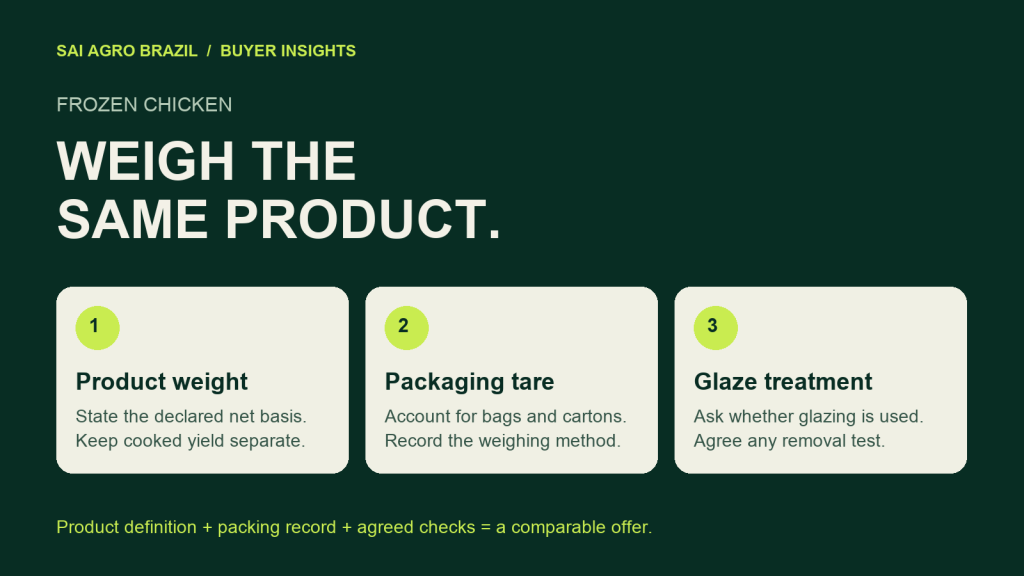
A carton marked with a weight is only the start of a frozen-chicken comparison. The buyer still needs to know what that weight represents, how packaging is treated, whether a glaze is present and how the delivered lot will be checked. Those details matter when offers use different pack formats or the receiving team must reconcile variable-weight pieces.
This guide focuses on weight and packing records. Use it alongside our chicken presentations guide, which covers choosing the cut and preparing the broader product brief.

Name the product before comparing kilograms
State the cut, bone and skin presentation, trim and any declared treatment or ingredients. A boneless-breast requirement and a bone-in leg-quarter requirement describe different products even if both arrive in cartons of the same nominal weight. Keep piece-weight bands and piece counts separate from carton net weight.
The USDA AMS frozen-chicken-parts purchasing specification, revised March 2024, illustrates how a formal procurement document distinguishes the product, inner packages, shipping container, net weight and label information. It is a United States purchasing programme reference, not a Brazilian export specification or a certification claim for SAI Agro Brazil.
Ask for three separate weight statements
- Declared net product weight: what is being sold as product under the agreed specification and applicable destination rules.
- Packaging tare: the bags, liners, cartons and other packaging accounted for in the weighing procedure.
- Gross shipping weight: the loaded shipping unit, with its included packaging or handling materials clearly identified.
Do not use gross shipping weight to calculate a net-product price. Ask which figure appears on the offer, carton label, packing list and transport documentation, and reconcile differences in scope before approval. Pallet weight is another handling detail to identify; it should not silently become product weight.
If glazing is used, agree how it is assessed
First ask whether the offered presentation is glazed. Do not assume that all frozen chicken uses a glaze or that every supplier reports it in the same way. Where relevant, request the declared basis, agreed tolerance and the procedure used to determine the product’s net contents.
NIST Handbook 133 includes a specific net-weight procedure for ice-glazed seafood, meat, poultry and similar products. Its existence is a useful reminder that a reproducible method matters. It does not make that United States procedure automatically applicable to every importing market. Have your technical or metrology adviser confirm the appropriate destination requirement and agreed test.
Make the carton calculation visible
Consider a planning example: 100 cartons, each declared at 10 kilograms net, give a nominal total of 1,000 kilograms net product. That arithmetic is not a tolerance rule, a sampling plan or evidence that a delivered load meets its declaration. For variable-weight cartons, request the actual carton or lot weights and reconcile their sum with the packing list.
Ask whether every carton contains one product and one lot, and whether mixed sizes or cuts are allowed. Obtain a sample label and show how its product name, lot code and weight connect to the packing list. If a count is approximate because piece weights vary, say so in the specification rather than presenting it as a fixed delivery guarantee.
Keep cooked yield as a separate evaluation
Net contents, thaw loss and cooked yield answer different questions. A net-weight declaration does not establish the output your kitchen or processing line will achieve. If usable yield matters to your decision, define a separate representative trial using your process, equipment and acceptance criteria. Record the method and compare like-for-like products under the same conditions.
Plan arrival checks with the receiving team: packaging condition, product identity, lot codes, weight records and transport-temperature evidence. Agree inspection timing, discrepancy records and the contractual claims route. Any opening, sampling or thawing must fit the operation’s food-safety procedures.
Build the packing section of your enquiry
Send the cut and presentation, inner-pack format, carton net weight or variable-weight basis, piece range, any glaze question, label requirements, lot traceability and the weight-check procedure you need. Add quantity, purchase frequency, destination country and port, shipment window and preferred trade term with its named place.
Start with boneless chicken breast, leg quarters or drumsticks, then send your purchasing brief. Final packing, availability, product specifications and destination eligibility are confirmed in the written offer.